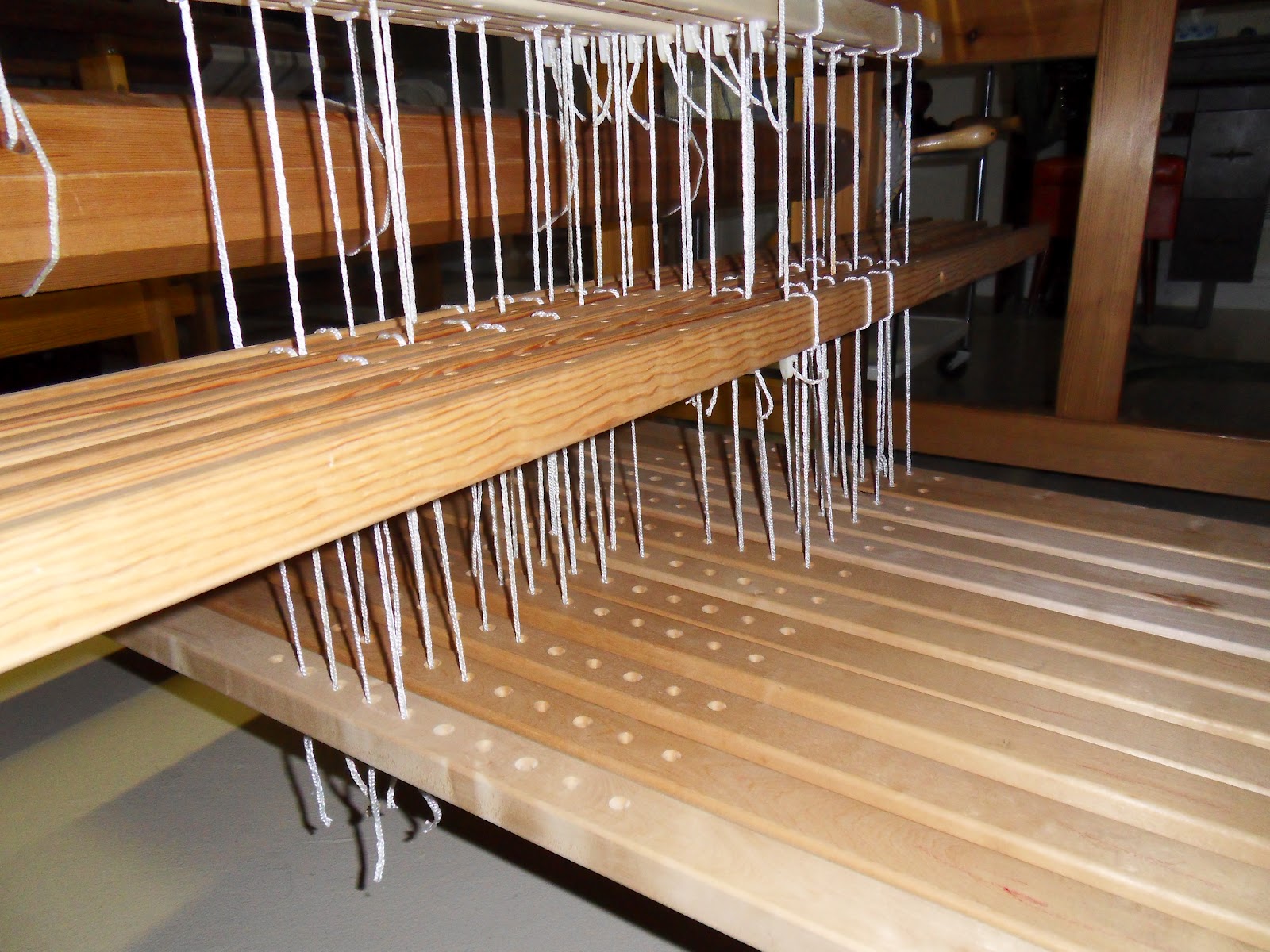
My Ideal 90 loom is returning to it's previous owner in Quebec City after a good 8 years with me. It is time to let my very first Glimåkra loom go.
My last project on this loom is a set of linen floorcloth taken from Väv Magasinet 2/10 woven on 6 shafts.
The loom is ready for it's next move. I replaced the linen cords with Texsolv.
Wednesday, October 03, 2012
Saturday, August 25, 2012
2nd throw
The is enough warp left on the loom for a second throw. I replaced the narrow stripes with different ones attached to a shaft stick for easier warp advancement.
The shaft stick is attached to the frame with 2 strings. After advancing the warp, adjusting these 2 strings until an even tension is obtained is all it needs instead of adjusting every single stripe separately.
It looks quite different than the previous (70's) one.
Saturday, August 18, 2012
Beautiful 70's
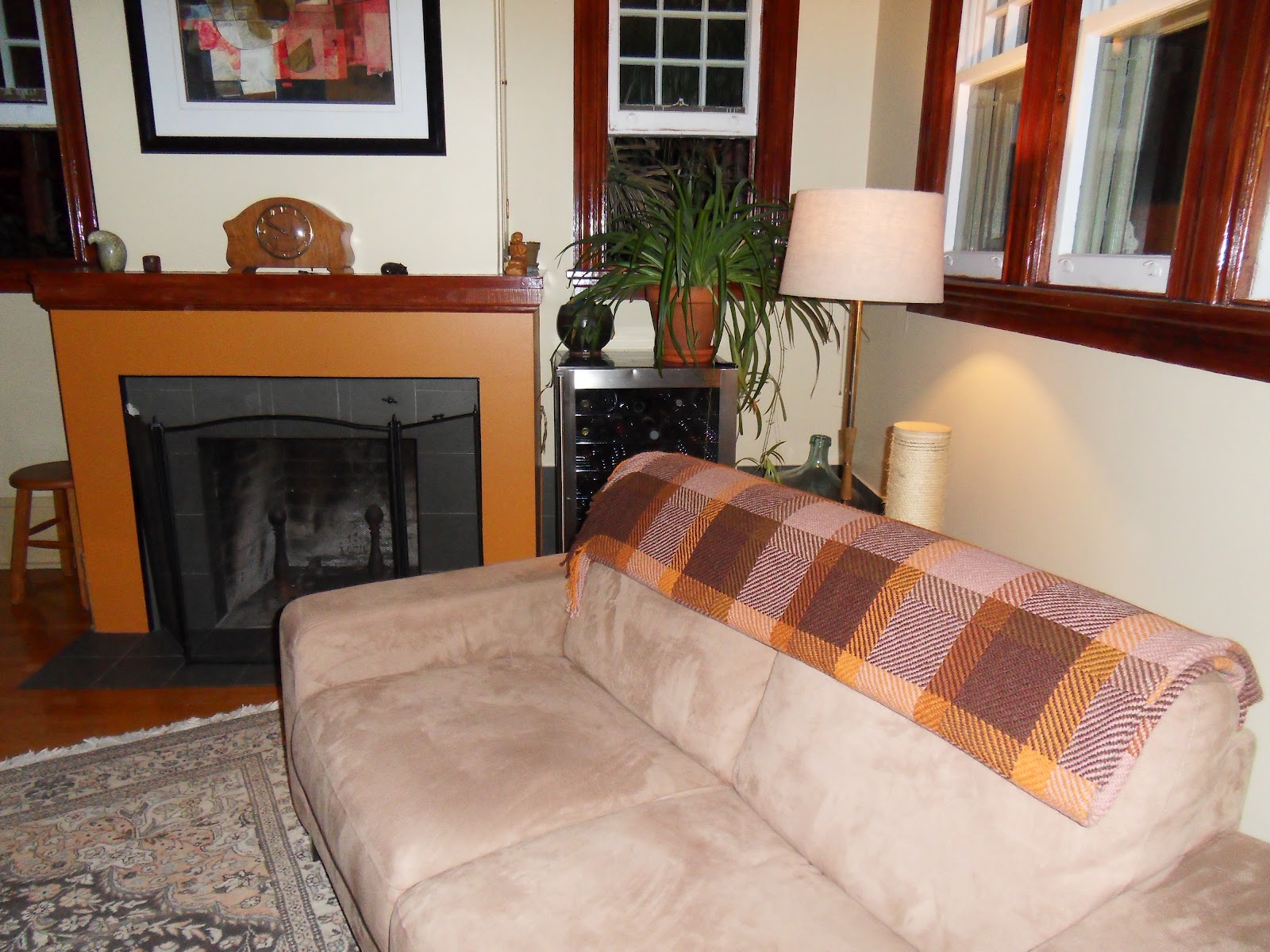
I finished weaving my first throw this morning. I am here twisting the fringes and must admit I like it a lot despite it's outdated colour scheme.
So the previously called ugly 70's colours turned into beautiful 70's and could not match any better in our living room. Am I plagued with bad taste? Please don't answer.
Tuesday, August 14, 2012
Ugly 70's or Autumn palette?
Some old second hand wool added up to my stash a good while ago and I need it to go. Call it ugly 70's or autumn palette if you wish but throwing it away is not an option. Maybe I secretely like this colour scheme I grew up in? Probably more an out-of-comfort-zone project.

Most of this two ply coarse wool it is dark brown and light pink, warped at 8 epi.

Creativity sometimes require adjustments... the two middle narrow stripes don't match and need to be replaced.

So does technique. A weighted warp offers decreasing resistance to an increasing pull while a fixed one offers an increasing (equal) resistance (well until it breaks). Combining both tension methods on the same project gives unequal tension. I had to think of something else and replace the weights with texsolv cord which allows fine tension adjustement on the modified sections and a constant behaviour when beating.

Why 8 shafts? to weave the first throw in broken twill and the second one in tabby. This project could be published in a magazine no? Well maybe, if this was 1972!

As usual, I had to build something: a temple wide enough for this loom.

Most of this two ply coarse wool it is dark brown and light pink, warped at 8 epi.
Creativity sometimes require adjustments... the two middle narrow stripes don't match and need to be replaced.
So does technique. A weighted warp offers decreasing resistance to an increasing pull while a fixed one offers an increasing (equal) resistance (well until it breaks). Combining both tension methods on the same project gives unequal tension. I had to think of something else and replace the weights with texsolv cord which allows fine tension adjustement on the modified sections and a constant behaviour when beating.
Why 8 shafts? to weave the first throw in broken twill and the second one in tabby. This project could be published in a magazine no? Well maybe, if this was 1972!
As usual, I had to build something: a temple wide enough for this loom.
Wednesday, July 04, 2012
smålandsväv
I once found this picture on the Internet and kept it for future use.
(http://riksvav.se/kronobergsvav/y11/feb11.html)

Last weekend, I warped the loom for my first Smålandsväv weave. It was also the first time I used a warping paddle and made a cross at both ends. I found out that the portée cross simplifies putting the warp up on the loom.

I drilled useless extra holes on the two middle treadles, right underneath the closest preset top harness beam. But I ended up with too much space between both harnesses. The back shafts are finally threaded on the 10th holes.

My samples... washed, pressed, then mangled. The ground weave in 2/9 linen, 18 ends/inch (7 ends/cm). A bit too open, Maybe I'll use a thicker ground weft. Blocks are 3x3 ends. Pattern weft used is cotton chenille (5 middle colours), 2/8 worsted wool (navy), single handspun wool (large top grey) and doubled 2/9 linen (bottom yellow). Wool gave the best results: weft shots are nicely sitting flat next to each other, slightly felted. Cotton chenille doesn't look at its best once pressed and worst after flat mangling, same as when just getting unrolled from the bobbin.

The first runner is woven with natural 2/8 worsted wool. There is 10 yards of warp wounded up on the back, hopefully enough for 3 or 4 pieces.

(http://riksvav.se/kronobergsvav/y11/feb11.html)
Last weekend, I warped the loom for my first Smålandsväv weave. It was also the first time I used a warping paddle and made a cross at both ends. I found out that the portée cross simplifies putting the warp up on the loom.
I drilled useless extra holes on the two middle treadles, right underneath the closest preset top harness beam. But I ended up with too much space between both harnesses. The back shafts are finally threaded on the 10th holes.
My samples... washed, pressed, then mangled. The ground weave in 2/9 linen, 18 ends/inch (7 ends/cm). A bit too open, Maybe I'll use a thicker ground weft. Blocks are 3x3 ends. Pattern weft used is cotton chenille (5 middle colours), 2/8 worsted wool (navy), single handspun wool (large top grey) and doubled 2/9 linen (bottom yellow). Wool gave the best results: weft shots are nicely sitting flat next to each other, slightly felted. Cotton chenille doesn't look at its best once pressed and worst after flat mangling, same as when just getting unrolled from the bobbin.
The first runner is woven with natural 2/8 worsted wool. There is 10 yards of warp wounded up on the back, hopefully enough for 3 or 4 pieces.
Thursday, June 28, 2012
Linen-cottolin scarf and rug samples
Thursday, June 07, 2012
Late with posting but busy weaving this spring.
I have been busier weaving than posting lately which is in a sense much better than having no time to
My first double-weave overshot sample is completed.

Then I wove a second one that looks like a regular single layer overshot but look closely and notice the different sections where the colour of the tabby colour becomes the pattern weft in the adjacent section.


After cutting these samples off, I re-slew everything to try the "sun, moon and stars" pattern found in Jennifer Moore's Doubleweave book with the remainder of the warp.

This loom doesn't have a counterbalance beam so I used three jacks on each side to hold the pulleys.

I also found out that putting a rubber band around the upper sticks on each side helps a lot stabilizing the shafts when weaving on a narrow warp.

The small loom was used for a cotolin tea towels project.


I also wove a matching narrow band to make suspending loops for these towels.

At our weaving Guild, I wove a few 8/2 cotton towels. The direct view we have on the waterfront is so inspiring.


And back home my last project was to weave a table runner using siberian iris leaves I cut and kept in the garage some 2 or 3 summers ago.

The loom is warpes with linen, mostly singles with narrow gaps between each colour sections. I used a repp technique where leaves are woven in groups of 6 and cut at about 6 inches from the selvage line.

The floor soon became a mess.

So did the table during the final trim

And here is the final product!

My first double-weave overshot sample is completed.
Then I wove a second one that looks like a regular single layer overshot but look closely and notice the different sections where the colour of the tabby colour becomes the pattern weft in the adjacent section.
After cutting these samples off, I re-slew everything to try the "sun, moon and stars" pattern found in Jennifer Moore's Doubleweave book with the remainder of the warp.
This loom doesn't have a counterbalance beam so I used three jacks on each side to hold the pulleys.
I also found out that putting a rubber band around the upper sticks on each side helps a lot stabilizing the shafts when weaving on a narrow warp.
The small loom was used for a cotolin tea towels project.
I also wove a matching narrow band to make suspending loops for these towels.
At our weaving Guild, I wove a few 8/2 cotton towels. The direct view we have on the waterfront is so inspiring.
And back home my last project was to weave a table runner using siberian iris leaves I cut and kept in the garage some 2 or 3 summers ago.
The loom is warpes with linen, mostly singles with narrow gaps between each colour sections. I used a repp technique where leaves are woven in groups of 6 and cut at about 6 inches from the selvage line.
The floor soon became a mess.
So did the table during the final trim
And here is the final product!
Wednesday, April 18, 2012
double weaving overshot samples
During the overshot class taken at our guild, I wanted to try weaving an overshot double weave sample.
I had (as usual) to start with making some new parts. 4 block requires 4 shafts and 6 threadles, multiply by 2 for double weave. My wider loom only has 10 threadles and it's lower lamm cannot accommodate more than that. Why are the lower ones for 12 threadles and the upper ones only for 10? That's what came with the loom...
| New upper lams and extra threadles |
Each layer needs it's own set of shafts, lamms and threadles, as if they were woven on separate looms.
| split tie-up, one group per layer |
I do not (yet) have a back harness (drawloom) for this loom but I still use long-eyed heddles and control the alternance of the layers manually with a pickup stick and a wide board.
| The flipped board replaces a rear harness |
| Side view of long eye heddles and open back shed |
I chose the same pattern on both layers and each layer's pattern picks are thrown immediately one after the other to switch layer in the same interstice. This improves the overall motif clarity and continuity. Top layer ground weft, bottom layer ground weft, top layer pattern weft, bottom layer pattern weft.
| Draft |
| Woven sample |
Tuesday, March 20, 2012
Loom add-ons and overshot samples
I am weaving 8 shafts overshot variation samples for a class I'm taking at our weaving guild.

Older Glimakra came with lower lamms of the same size than the upper ones. I made new thicker and longer lower lamms to help balancing the shafts. But still the new ones still weren't heavy enough, I attached a couple of 12" nails to each of them with rubber bands. I often use this trick on my wider loom.

Also made two extra threadles, the loom only came with 8.

Plus a wooden loom fluorescent light box.
Older Glimakra came with lower lamms of the same size than the upper ones. I made new thicker and longer lower lamms to help balancing the shafts. But still the new ones still weren't heavy enough, I attached a couple of 12" nails to each of them with rubber bands. I often use this trick on my wider loom.
Also made two extra threadles, the loom only came with 8.
Plus a wooden loom fluorescent light box.
Subscribe to:
Posts (Atom)